
Rydberg atoms team
The Rydberg atom team works on the construction of a quantum simulator platform built on individual highly-excited circular atoms for fondamental studies as well as practical applications.
Circular Rydberg atoms are highly excited atoms (high principle quantum number 𝑛) with maximal angular (𝑙=𝑛−1) and magnetic (𝑚=𝑙) quantum numbers. Their toroïdal orbits have large size (𝑟~1/4 𝜇m for 𝑛~50) and, hence, large induced dipole moment (𝑑~1800 𝑒𝑎0), making them very sensitive to external fields (electric, magnetic...) as well to other Rydberg atoms over several micrometer distances. Finally, these atoms exhibit very long lifetimes on the order of 𝜏~30 ms.

Over the last more than 30 years, these atoms have been successfully used in fundamental research, for instance in a cavity QED system to control and measure in a non-destructive way quantum
states of trapped light. Nowadays, these atoms attract much attention and find their place in advanced quantum technologies, like quantum metrology, quantum information and quantum
simulation.
The main objective of our group is to develop a quantum simulation platform built on individual circular Rydberg atoms trapped in a programmable array of optical microtraps. Being placed
inside a specially designed plane-parallel capacitor (2-𝑚𝑚 plate distance), the atomic spontaneous emission can be strongly suppressed (theoretically, up to several minutes), making them
promising for long quantum simulation protocols, e.g. for studying thermalisation or adiabatic processes. More generally, our aim is to develop a new tool to control and protect fragile
quantum systems against relaxation.
Our previous studies on the cavity QED with Rydberg atoms can be found here.
Current members:
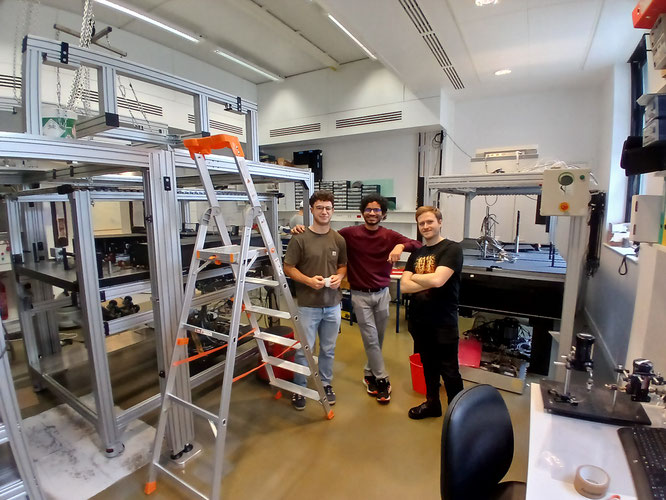
Gauthier Rey, Ankul Prajapati, Guillaume Cœuret Cauquil
Absent : Julien Mauchain, Igor Dotsenko
Latest news:
PhD defense of Guillaume Cœuret Cauquil
12 January 2026
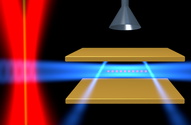
The PhD thesis is entitled "Towards realisation of long-lived ensembles of circular Rydberg atoms" and presents in detail the design, the construction and the first tests of a new Rydberg atom experiment aiming to extend the atomic lifetime by several orders of magnitude, up to a minute range, by protecting them from spontaneous emission.
Our warmest congratulations for the excellent work and results!
Irreversibility of decorrelating processes: an experimental assessment in cavity QED
January 2026
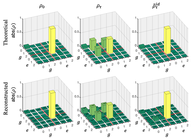
In our last series of experiments performed in the two-cavity setup, we have experimentally simulated and studied the irreversibility of different decorrelation processes.
https://arxiv.org/abs/2601.07011
First Circular Rydberg atoms in Occitanie !
Merry Christmas 2025
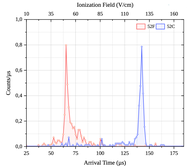
We have obtained the first clear signal of the circularisation of the cooled and transported atoms. This state preparation process transforms a low-angular-momentum Rydberg state (52F) into the circular one (52C) by forcing the atoms to absorb 49 radio-frequency photons.
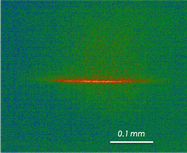
Delivering atoms with a "conveyor belt"
Spring 2025
After the move to the new lab, rebuilding and optimisation of the experimental setup, we have finally got the dipole trap in a standing-wave configuration able to transport ground-state atoms between the magneto-optical trap and the inhibition capacitor (14-mm distance).

Our D-Day: moving from Paris to Toulouse
Halloween 2024
During the automne vacations, three trucks have moved our experiment from the Collège de France in Paris to Laboratoire Collisions Agrégats Réactivité in Toulouse. From now on, we are official toulousains!

New professor position at Université de Toulouse
January 2024
The start of a new position, a new groupe and a new research direction at the University of Toulouse